

 X
X

 Facebook

 Linkedin

 Email
Email
 Copy Link
When it comes to Quick Service Restaurants, the scale of the industry can be staggering.
According to a ten-year report published by QSR Magazine in 2025, the top 50 QSRs generate more than $350 billion in annual sales, and that could be an underestimate. A December 2025 report by Fortune Business Insights projected the overall QSR to grow to almost $600 billion by 2032, fueled by consumers who want casual, quick, and affordable dining.
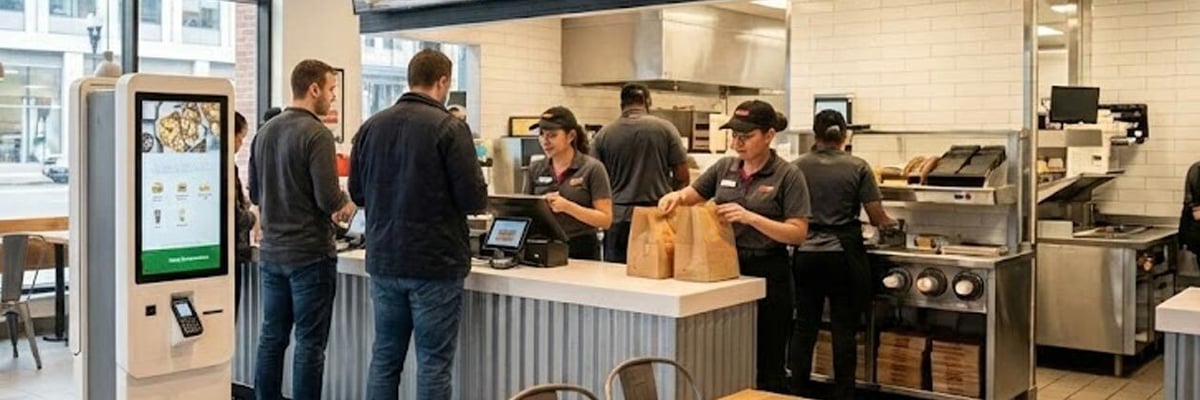
But while QSRs are the backbone of the American food industry, they face a constant, high-stakes hurdle: high turnover and the constant need to onboard new hires.
Turnover in the QSR Sector - a Constant Struggle
Recent data highlights the challenge QSRs face from high turnover.
Earlier this month, the U.S. The Bureau of Labor Statistics reported that accommodation and food services posted a quit level of 4.8%, more than double the average of 2.2%. And for countless QSRs, turnover rates can easily exceed 120 percent. According to restaurant industry data and insights provider Black Box Intelligence, the average cost of replacing one hourly restaurant employee was $2,706 in 2025.
In 2022, the National Restaurant Association listed 6 top reasons employees leave hospitality companies, including lack of growth opportunities (23%), pay/benefits (22%), poor job fit (20%), and workplace culture (17%).
Turnover is clearly one of the top challenges facing QSRs, and the solution begins the moment employees walk through the door for their first shift.
Better onboarding can help stave off high turnover
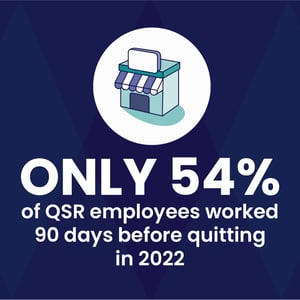
A 2023 study found that nearly half of all QSR employees who left their positions did so within their first 90 days on the job. The first 48 hours an employee spends at a restaurant can be crucial. Thrown into the frying pan, these employees must learn the ropes quickly and there is little room for error. How these first shifts play out has a major impact on the future of the employee at the establishment.
One of the best ways companies can offset the high cost of turnover is to hit the ground running with effective, streamlined onboarding that includes:
- Digital paperwork: Ditch the forms and get the admin tasks out of the way in a flash
- Mobile-first training: Provide eye-level, video-based training consistent with how people learn in 2026.
- Custom courseware: Provide targeted training that is more relevant and more likely to stick.
- Micro-learning: QSR employees don’t have time for 20-minute modules and long training sessions. “Micro-learning” modules are key.
- Bilingual learning: Traditional paper-based training and shadowing struggle to provide the multilingual support necessary for today’s QSRs.
These methods and tools get employees up to speed faster, helping them learn the menu, their daily tasks, and the makeup of the company’s culture and products. Also, more effective, eye-level training that speaks to the employee’s specific job requirements helps bolster their confidence as they learn the ropes at their new position.
Better onboarding helps cut costs by improving efficiency
“In a business where one in every two new hires will leave within three months, every hour saved on onboarding and training costs matters. It’s time to stop treating training as another box to check and start seeing it as a critical lever for running a sustainable, profitable restaurant,” Eran Heffetz, Co-Founder and CEO of Bites, wrote in QSR magazine in August 2025.
Streamlined, job-specific onboarding helps reduce downtime by more directly addressing the mission-critical tasks that new hires will have to perform during the workday. This accelerates the time to proficiency for a new kitchen or front-of-the-house employee, reducing the errors and time stoppages spent asking questions about procedures.
More effective onboarding and training also helps veteran employees stay efficient and reduces veteran burnout by cutting the amount of time they’ll need to spend training the new hire or having them shadow them on the restaurant floor.
Better onboarding improves safety culture and reduces risk
Effective onboarding and training is the foundation of a strong food safety culture, defined by the Global Food Safety Initiative as “shared values, beliefs and norms that affect mindset and behaviour toward food safety in, across, and throughout an organization.”
Effective onboarding not only teaches new hires the critical safety guidelines but also the why behind these obligations. This helps in at least two critical ways:
Team building and belonging: Employees learn that they are essential to the safety culture at the restaurant, creating a better sense of belonging and ownership in the success and safety of the establishment, helping address the “lack of growth: sentiment that increases turnover.
Risk mitigation: Employees better understand the gravity of safety tasks, discouraging them from cutting corners or just going through the motions while they’re in the weeds before, after, or during a busy service.
The Rootwurks LMS - Streamline Onboarding, Enhance Safety, Cut Turnover
With Rootwurks, QSRs can ditch the boring training manuals and videos and build custom training that boosts retention and helps new hires get up to speed swiftly and safely.
The Rootwurks advantage for QSRs:
- Build a robust food safety culture that doesn’t slow down the workflow
- Create customized, efficient training that resonates with employees
- Seamlessly create consistent training for all branches
- Ensure restaurants and employees are audit-ready, no matter the workflow
- Easily track, verify, and validate safety and compliance training